
Local SEO
Local SEO that helps nearby customers find you
Website-level local search optimisation, keyword research, page structure, on-page content and the local information that helps the right customers find your services.
Local SEO is often sold as a mystery. In plain terms it is the work of making sure your website clearly describes the services you offer and the areas you cover, so search engines and, more importantly, nearby customers can understand it.
I work on the parts I can control honestly: research, page structure, on-page content and the local information the business genuinely has. I am upfront that SEO is an ongoing effort, and I do not promise rankings or enquiry numbers.
AT A GLANCE
Service type
Platform
WordPress
Serving
Australia-wide, including Sydney
Best suited to
Lawn care, gardening and landscaping businesses
Local search, explained without the jargon
Three ideas do most of the work before any technical detail matters.
Match what people search
Pages should use the same language customers use, so a clear match exists between what they type and what you offer.
Make the area clear
Service areas and locations need to be stated plainly, so the site is understood for the places you actually work.
One page, one purpose
Each page targets a distinct service or service area, so pages support each other instead of competing.
Keyword research and search-intent analysis
Before changing anything, the work is to understand what customers search and what they are actually hoping to find.
Keyword research
Identifying the service and location phrases real customers use, with a realistic view of competition in each market.
Search-intent analysis
Separating people ready to enquire from people still researching, so each page answers the right stage.
Keyword clustering
Grouping related phrases into themes, so a single well-built page can serve a whole cluster rather than creating thin duplicates.
Page mapping
Assigning each cluster to one page, so every important service and area has a clear home with no cannibalisation.
Foundations
Speed, usability and technical foundations
The unglamorous work that keeps a site quick, accessible and easy for search engines to understand.
On-page SEO
Titles, headings, content and internal links structured around each page’s primary theme.
Service-page planning
A dedicated, well-written page for each core service, with genuinely useful detail rather than filler.
Location-page planning
Genuine local pages where a business actually serves an area — never thin suburb pages created only to chase a search term.
Internal linking
Connecting services, service areas and projects so both visitors and search engines find related pages.
Technical SEO basics
Readable URLs, sensible metadata, crawlability, image alt text and canonical handling where needed.
Local profile
Google Business Profile, where appropriate
For businesses with a real, verified location or service area, the profile is often the first thing customers see.
Profile accuracy
Business name, category, hours and service area reviewed so the profile matches the website and reality.
Photos and services
Guidance on the images and service listings that make a local profile feel current and credible.
Reviews, handled honestly
A simple approach to asking genuine customers for reviews never purchased, never invented.
Audits
Google Business Profile, where appropriate
If you are unsure where to start, an audit gives you an honest picture before any work is agreed.
Structure review
A check that important services and areas each have a clear, dedicated page worth ranking.
On-page review
A plain-English look at titles, headings, content and internal links across the site.
Prioritised recommendations
A short, ordered list of what to fix first, with the reasoning, no hundred-page report for its own sake.
The workflow
A transparent SEO workflow
01
Audit and research
Review the current site and profile, then research the keywords and search intent that matter to the business.
02
Map the pages
Cluster keywords and map them to pages, agreeing which services and areas get dedicated coverage.
03
Optimise and implement
Apply the agreed on-page changes, internal links and technical fixes, and plan any new pages.
04
Review and refine
Report plainly on what changed and why, and agree sensible next steps with no hype about outcomes I cannot guarantee.
- SEO is an ongoing effort rather than a one-off switch. I cannot promise first-page rankings or a specific number of enquiries, and I will not pretend otherwise.
What this delivers for the business
01
A clearer site
Both people and search engines understand what each page is about.
02
Content that matches demand
Pages line up with the services and areas you actually want to win.
03
Honest, scoped work
Everything is explained before it starts, with no inflated promises.
Relevant work
Projects that show the same thinking
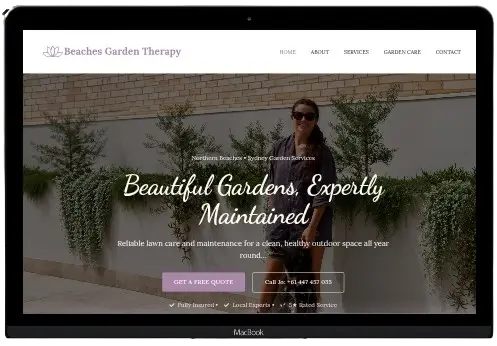
Garden Maintenance
A clear one-page structure for a residential mowing service, built so a visitor can see the services, the suburbs covered and a quote button before they scroll twice.
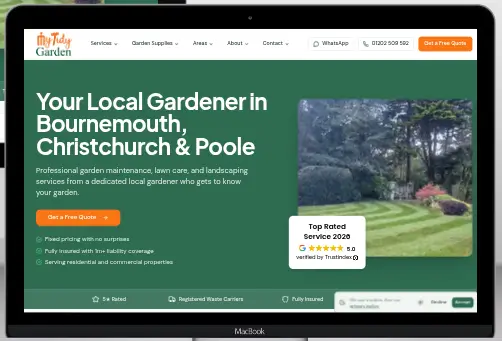
Lawn Care website
A clear one-page structure for a residential mowing service, built so a visitor can see the services, the suburbs covered and a quote button before they scroll twice.
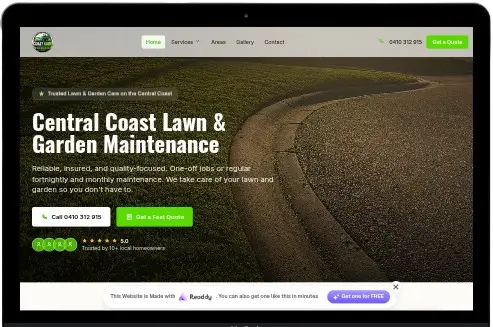
Lawn & garden maintenance
A clear one-page structure for a residential mowing service, built so a visitor can see the services, the suburbs covered and a quote button before they scroll twice.
Local SEO — FAQs
The questions I am asked most often, answered honestly including the ones about what I will not promise.
I do not give fixed timelines or ranking promises, because they depend on competition, your existing profile and how consistently the work is done. What I can offer is a clear plan, honest reporting and changes made for defensible reasons.
No, and no responsible specialist should. Search results depend on factors well beyond any one website. I focus on the things that are genuinely within our control and explain them plainly.
Not at all. An audit of your existing site is often the best starting point, and many improvements can be made without a rebuild. If a new page or structure is needed, that can be scoped separately.
No. I only recommend location pages where a business genuinely serves that area and there is real value in the page. Thin suburb pages created purely to target a search term do more harm than good.